Detecting Neutrons
Charged-particle detection is a charge-counting problem. An alpha or beta ionizes matter directly and you collect the charge, or the scintillation light it produces. Gammas are uncharged but still tractable: they generally interact with the electron cloud through the photoelectric effect, Compton scattering, and pair production (nuclear/nucleus interaction), and the photoelectric cross-section scales roughly as Z^4 to Z^5. That one fact tends to organizes gamma detector material selction: you reach for high-Z materials like HPGe and NaI(Tl) to detect, lead and tungsten to shield. Everything tracks atomic number.
Neutrons break that intuition. A neutron is neutral and barely interacts with electrons, so it passes through biased silicon and doped scintillator without ionizing much of anything, and crosses centimeters of solid material unannounced. And because the interaction is nuclear rather than atomic, the useful absorbers are not ordered by Z. They are a scattered set of specific isotopes with large thermal capture cross-sections set by nuclear structure and resonances: He-3, Li-6, B-10, Cd-113, Gd-157. There is no "use a heavier element" rule. You memorize the isotopes.
Convert the neutron to charged particles
Since you cannot detect a neutron directly, you give it to a nucleus with a large capture cross-section and detect the charged products. The reaction does the conversion from neutral to ionizing:
- Helium-3:
n + 3He -> p + 3H, Q = 0.76 MeV. The basis of He-3 proportional counters. - Boron-10:
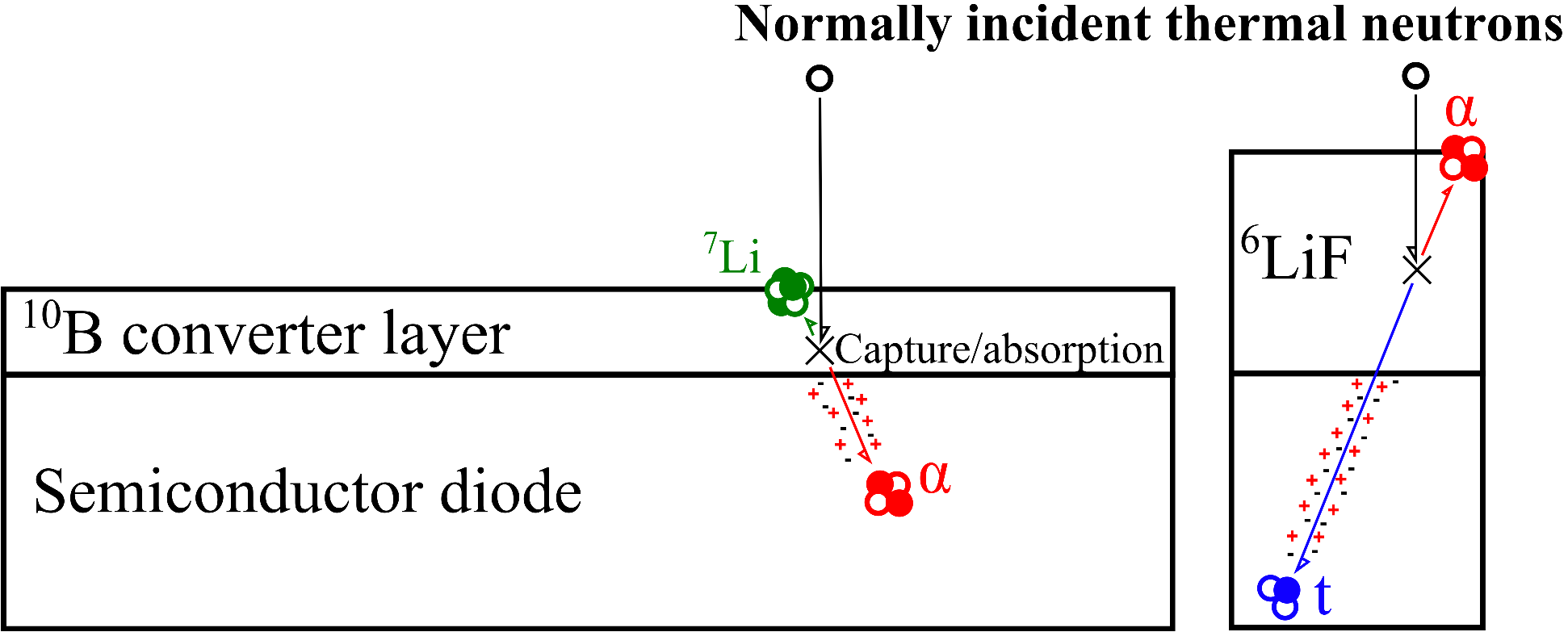
n + 10B -> 7Li + alpha, ~2.3 MeV split between an alpha and a lithium recoil. - Lithium-6:
n + 6Li -> 3H + alpha, ~4.8 MeV split between a triton and an alpha.
Gas, scintillators, and solid converters
He-3 tubes were the default for decades, until it became clear He-3 is scarce: it is mostly a tritium-decay byproduct from the weapons stockpile, and demand spiked when radiation portal monitors went up at borders. The resulting shortage funded a decade of "alternatives to He-3" work. Boron shows up as BF3 in proportional tubes, cheaper but corrosive and toxic. You can also put the converter in a solid: Li-glass, or Li-6 / B-10 loaded plastics, where capture and scintillation happen in the same matrix. These are more rugged, especially if you use a silicon photomultiplier and not a traditional vacuum tube based photomultiplier, but they are still hard to scale to large areas.
Thin-film semiconductor detectors
This is what I did in grad school at UT-Dallas. Take a semiconductor diode, which counts charged particles cleanly, and put a thin converter film of Li-6 or B-10 against it. A neutron captures in the film, and a charged reaction product crosses into the depletion region as an ordinary ionization event. If your diode and converter material are low cost, then this approach CAN economically scale to large areas.
The constraint is geometry versus self-absorption. Too thin a converter and most neutrons pass without capturing; too thick and the reaction products range out in the film before reaching the junction, so there is a narrow optimum thickness. We identified polycrystalline CdTe as a cheap, large-area sensor material and modeled the optimum diode and converter thickness in MCNP. Details are in the papers: Optimizing diode thickness for thin-film solid state thermal neutron detectors (APL, 2012) and Thin film cadmium telluride charged particle sensors for large area neutron detectors (APL, 2014).
 hover / hold for original
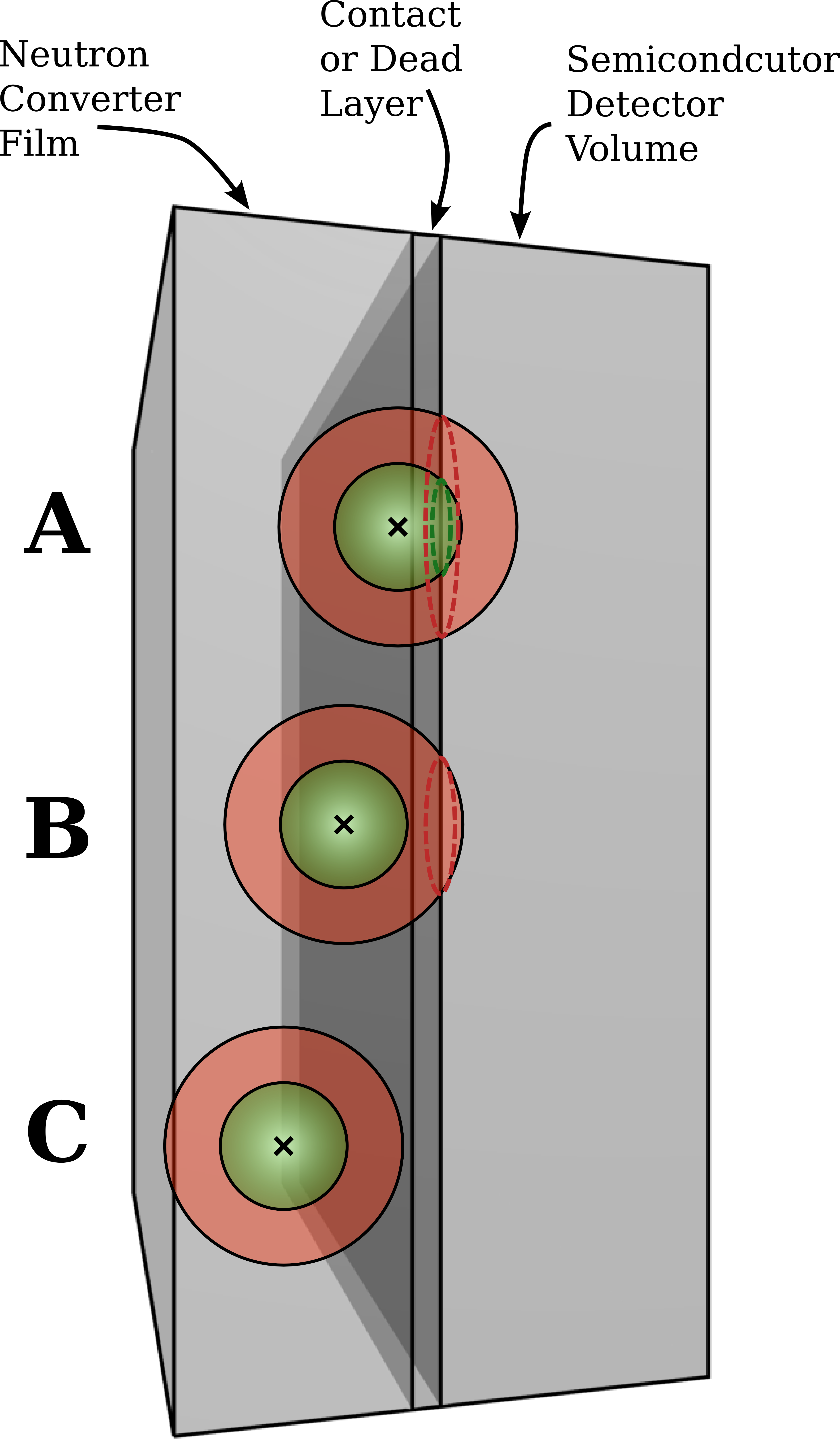
A flat film wastes most of the converter, so getting more converter near more active volume is why people move to microstructured devices: etched trenches and pillars backfilled with converter.
 hover / hold for original
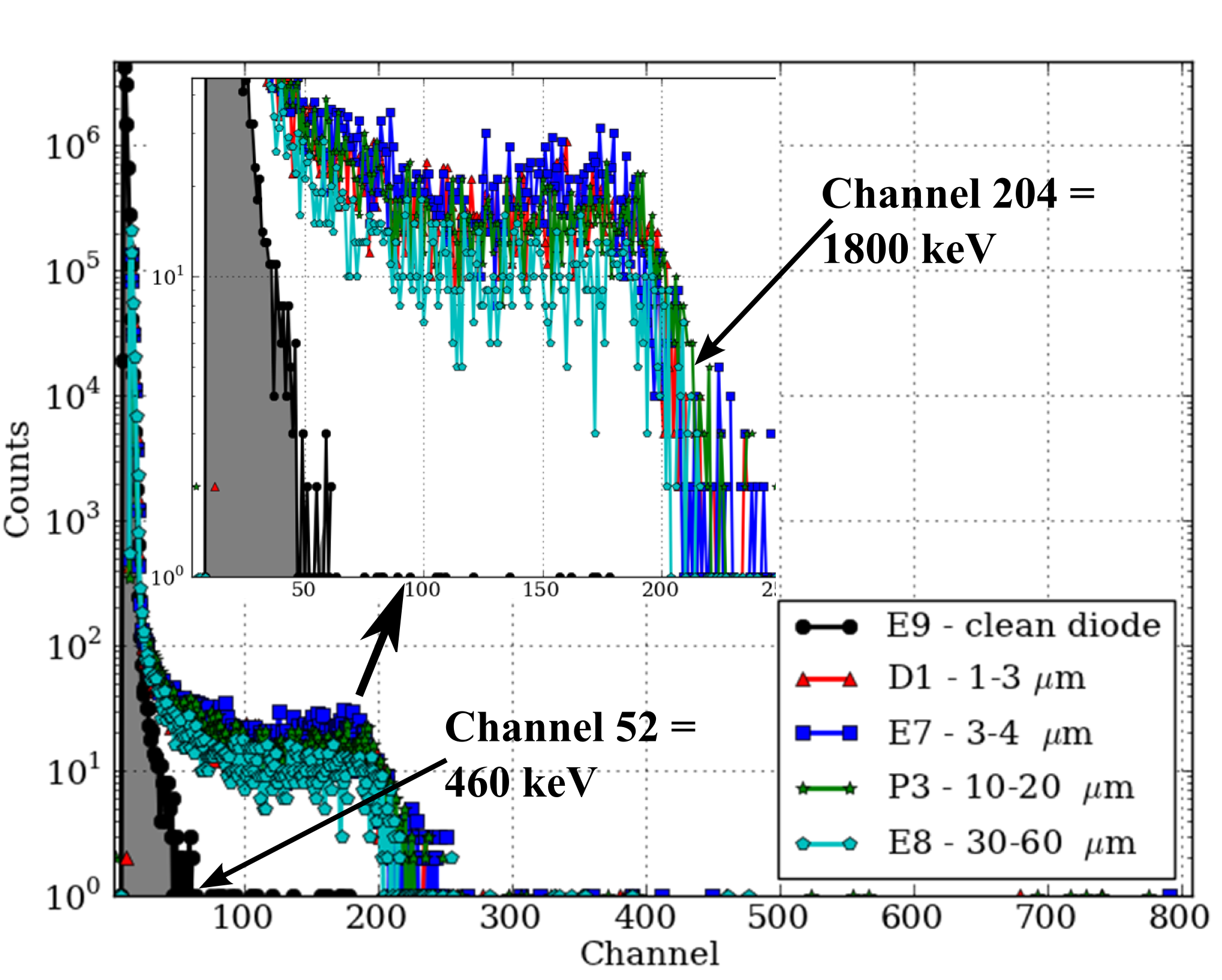
Here is one of those devices working: measured pulse-height spectra from converter-coated silicon diodes under a neutron source, across several converter thicknesses, against a bare diode (E9).
 hover / hold for original
Thermal vs fast, and the barn
Those capture cross-sections are large for slow neutrons and small for fast ones. A fission neutron is fast (order MeV) and most converter nuclei ignore it. The fix is moderation: surround the detector with a hydrogen-rich material like polyethylene so neutrons scatter off light nuclei and lose energy until they are thermal. Cross-sections are measured in barns (10^-28 m^2); thermal capture for Li-6, B-10, and He-3 runs into the hundreds to thousands of barns, versus orders of magnitude less when fast.
Why it matters
Neutron counting is central to safeguards and nonproliferation: plutonium and other special nuclear material emit spontaneous-fission neutrons that escape even when the gammas are shielded, so a neutron signature is hard to hide. It also shows up in reactor instrumentation and in oil-and-gas well logging.
If you want to simulate this yourself, I wrote some open-source GEANT4 radiation labs. Detector and shielding modeling is also part of the consulting I do now.