Radioisotope Batteries
A radioisotope battery converts the energy released by radioactive decay into electricity. The appeal is energy density: the energy per gram in nuclear decay is orders of magnitude above any chemical cell. The constraint is power (along with shielding, manufacturability, and other practicalities). You do not set the decay rate, the half-life does, so the output is a small, steady trickle (often microwatts to milliwatts) that runs for years to decades. That fixes the application space: low power, long life, somewhere you cannot recharge or service. Outside that niche, chemical batteries possibly in combination with other power geenration methods win.
There are two main families:
Thermal: RTGs
The radioisotope thermoelectric generator heats one side of a thermocouple with decay heat from an alpha emitter (usually Pu-238, half-life ~88 years) and harvests the gradient via the Seebeck effect. No moving parts. Conversion efficiency is a few percent; the rest is waste heat, which also keeps the spacecraft warm. RTGs power the Voyager probes and the Curiosity and Perseverance rovers, where solar is not an option. This is the mature, flight-proven approach, and it is not what I worked on.
Direct conversion: betavoltaics and alphavoltaics
The other family skips the heat step and converts particles to current directly. A betavoltaic places a beta emitter against a semiconductor junction; the betas generate electron-hole pairs that the junction collects, the same physics as a photovoltaic with beta particles as the source. Alphavoltaics do the analogous thing with alpha emitters, with the complication that alphas deposit energy densely and damage the semiconductor lattice, so you either harden the device or move the conversion out of the solid.
At LLNL I worked in Rebecca Nikolic's group, ending as co-PI on the radioisotope battery project, pushing the power density of these direct-conversion devices across modeling, fabrication, and characterization. Four main concepts:
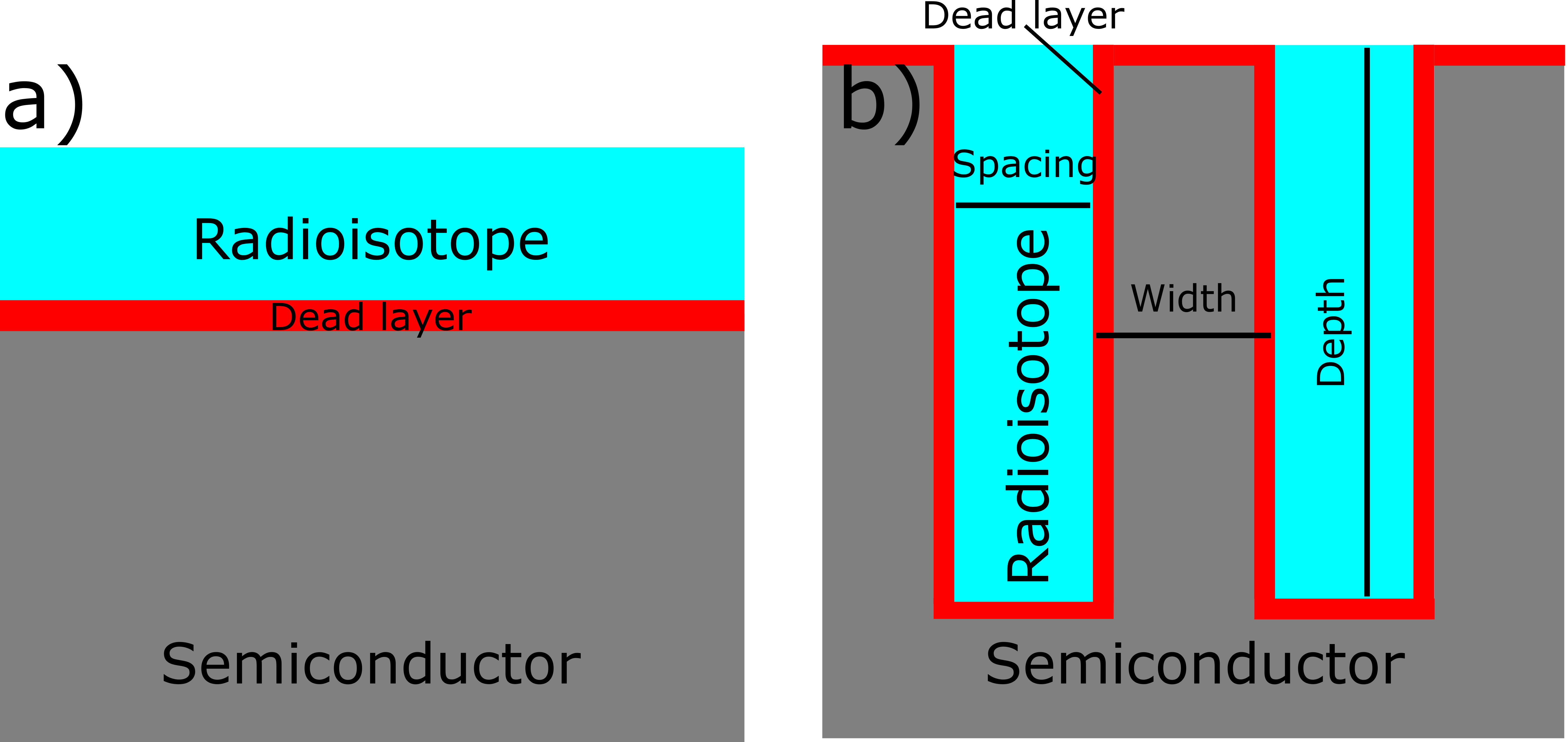
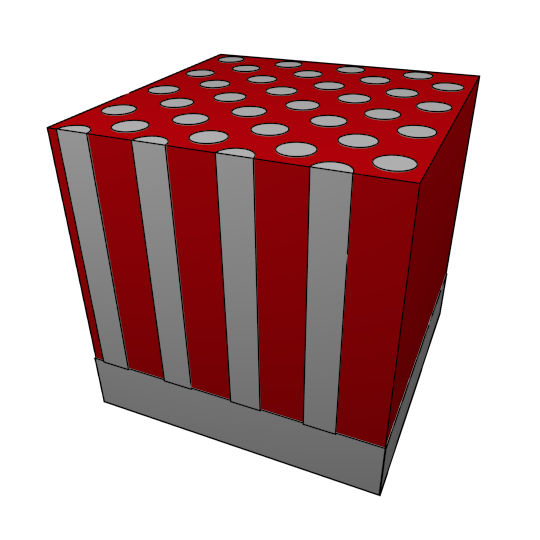
- High-aspect-ratio 3D semiconductor betavoltaics. The power density of a planar junction is capped by the source you can fit on a flat surface. Etching deep 3D structure increases the source-to-junction interface area per footprint. Our primary device work used Pm-147, a pure low-energy beta emitter with a ~2.6 year half-life. The modeling was general; the fabricated devices used Pm-147. See Design considerations for three-dimensional betavoltaics (AIP Advances, 2019) and Demonstration of a Three-Dimensionally Structured Betavoltaic (Journal of Electronic Materials, 2021).
- Liquid-semiconductor alphavoltaics. A liquid semiconductor conformally surrounds the source and self-heals the lattice damage that wrecks solid alphavoltaics. We worked on a selenium-based eutectic for this: Selenium-iodide: A low melting point eutectic semiconductor (APL, 2018). This work also resulted in a patent.
- Gas scintillator alphavoltaics. Convert alphas to light in a high-pressure noble gas (xenon), then convert the light with a photovoltaic. The scintillator is immune to displacement damage because it is a gas.
- Rad-hard scintillator betavoltaics. Convert high energy gammas from common high energy beta sources to visible light, which is then collected in a traditional solar cell to generate power. We received several patents for this work: Patent 1 Patent 2, and also published this in IEEE Transactions on Nuclear Science.
 hover / hold for original
 hover / hold for original
Isotope selection is the hard part
Picking the source is a multi-way optimization: short half-life gives more power now but a shorter life; long half-life lasts but barely produces; emission type sets the shielding burden (alphas and low-energy betas are easy, gammas and neutrons are not); and then availability and cost, which is why Pu-238 is excellent but also perpetually scarce. We also need to consider the energy of the source particle and how it will interact with (and hopefully not damage) the absorber material(s).
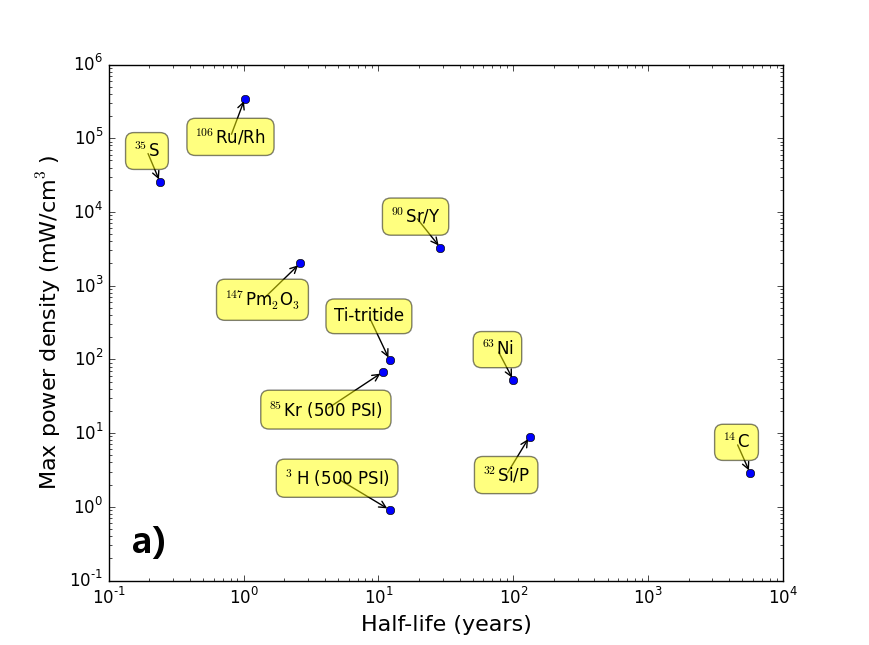 hover / hold for original
The reason these are not consumer products is regulatory, not technical. A radioisotope battery is a sealed radioactive source in the public's hands, with the licensing, accident analysis, and end-of-life handling that implies. Cardiac pacemakers used Pu-238 sources in the 1970s and worked well, but lithium cells got good enough that nobody wanted to manage the radioactive waste. The technology wins only where there is no recharge, no replacement, and no alternative.
Most of the engineering lives in transport modeling: where the decay energy actually deposits, how the source self-absorbs, how materials degrade under their own radiation. That is a chunk of what I do now through nuclear and radiation modeling, and there are hands-on GEANT4 labs if you want to try your hand at learning to simulate these processes. The rest of the LLNL-era papers are on my Google Scholar.