WELCOME TO THE WORLD OF ZERO-KNOWLEDGE PROOFS
This comprehensive overview explores Zero-Knowledge Proofs (ZKPs), from their fundamental concepts to their cutting-edge applications. ZKPs are a revolutionary cryptographic method allowing one party (the prover) to prove to another party (the verifier) that a statement is true, without revealing any information beyond the validity of the statement itself.
WHAT ARE ZKPs?
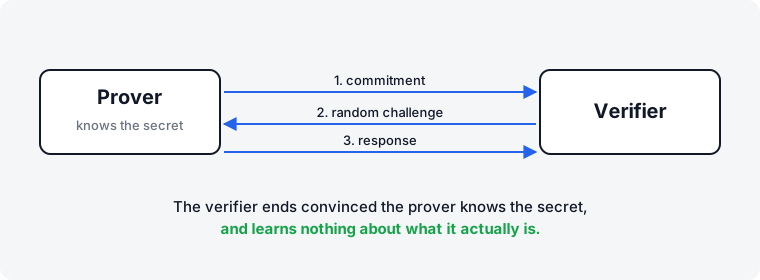
Zero-Knowledge Proofs (ZKPs) allow a prover to convince a verifier that a statement is true, without revealing any information beyond the statement's validity. Imagine proving you know a secret password without ever showing the password itself. This is the essence of ZKPs – proving knowledge while preserving secrecy.
 hover / hold for original
THE THREE PILLARS OF ZKPs
1. COMPLETENESS
If the statement is true and both prover and verifier are honest, the prover will successfully convince the verifier. This ensures the system works for valid proofs.
2. SOUNDNESS
If the statement is false, no dishonest prover can convince an honest verifier that it's true (except with a tiny, negligible probability). This prevents cheating.
3. ZERO-KNOWLEDGE
If the statement is true, the verifier learns nothing beyond the fact that the statement is true. No secret information (the "witness") is leaked.
ZKPs VS. TRADITIONAL PROOFS
Traditional mathematical proofs are transparent, revealing why a statement is true. ZKPs are different:
- Often interactive (though non-interactive versions exist)
- Probabilistic: Soundness guarantees are computational, not absolute certainty
- Rely on cryptographic assumptions (e.g., difficulty of certain math problems)
- Goal: Verify truth without revealing underlying data
The paradigm shift introduced by ZKPs redefines "knowledge" in proofs. Instead of knowledge transfer, ZKPs aim for knowledge concealment. This has paved the way for privacy-preserving technologies in finance, identity, and more, allowing verification without compromising sensitive data.
THE JOURNEY OF ZKPs: HISTORICAL GENESIS
The concept of Zero-Knowledge Proofs wasn't born overnight. It emerged from foundational theoretical work in computer science and cryptography.
KEY MILESTONES & CONCEPTS
■ 1985: GOLDWASSER, MICALI, RACKOFF (GMR)
The seminal paper "The Knowledge Complexity of Interactive Proof-Systems" formally introduced ZKPs. They defined "zero-knowledge" and provided first examples for problems like quadratic residuosity. This marked the conceptual birth of ZKPs.
■ EARLY 1990s: GMW PROTOCOL
Goldreich, Micali, and Wigderson showed that all problems in NP (a large class of computational problems) could have ZKPs, assuming one-way functions exist. This vastly expanded ZKPs' theoretical scope, using Graph 3-Coloring as a key example. However, it was impractical for real-world use.
■ FORMALIZING ZERO-KNOWLEDGE: SIMULATOR & EXTRACTOR
- Simulator: Proves "nothing was learned" by showing a simulated proof (without the secret) looks identical to a real one
- Extractor: Ensures "proof of knowledge" by demonstrating that any successful prover must possess the secret witness
■ LATE 1980s/EARLY 1990s: FIAT-SHAMIR HEURISTIC & NIZKs
The Fiat-Shamir heuristic transformed interactive "public-coin" proofs into Non-Interactive Zero-Knowledge Proofs (NIZKs). This was a major step towards practical ZKPs, especially for asynchronous systems like blockchains, often using Σ-protocols as a base.
The early theoretical work laid a robust foundation but also highlighted the gap between theory and practice. The GMW protocol, while monumental, was too inefficient. This spurred decades of research to create the efficient and practical ZKP systems like zk-SNARKs and zk-STARKs we see today, driven by the need for privacy and scalability in emerging digital systems.
ZKP TECHNOLOGIES: A CLOSER LOOK
Building on theoretical foundations, researchers have developed various ZKP constructions. This section explores the most prominent ones: zk-SNARKs, zk-STARKs, and Bulletproofs.
ZK-SNARKS
Zero-Knowledge Succinct Non-Interactive Arguments of Knowledge
- Zero-Knowledge: Proof reveals nothing but validity
- Succinct: Proofs are very small (constant or log size) and fast to verify. Crucial for blockchains
- Non-Interactive: Single proof, no back-and-forth
- Arguments of Knowledge: Prover must "know" the secret witness
⚠️ Trusted Setup: Many (e.g., Groth16) require a one-time setup phase generating parameters with "toxic waste" (secret randomness). If compromised, soundness breaks. MPC ceremonies (e.g., Zcash's "Powers of Tau") distribute this trust. Newer SNARKs like PLONK offer universal/updatable setups, and Halo 2 (used by Zcash Orchard) is trustless.
Mathematical Machinery:
- Arithmetization: Computation to algebraic constraints (e.g., R1CS - Rank-1 Constraint System)
- QAP Transformation: R1CS to Quadratic Arithmetic Program (polynomial equation)
- Probabilistic Check: Elliptic curve pairings check the QAP efficiently and in zero-knowledge
Key SNARK schemes include Groth16 (very efficient, circuit-specific setup) and PLONK (universal/updatable setup, more flexible). The trend is towards reducing or eliminating trusted setups.
ZK-STARKS
Zero-Knowledge Scalable Transparent Arguments of Knowledge
- Scalable: Handles large computations (prover time O(N log N), verifier poly(log N))
- Transparent: ✓ No trusted setup. Uses public randomness
- (Potentially) Quantum Resistant: Relies on hash functions, considered more resistant to quantum attacks
Mathematical Machinery:
- Arithmetization (AIR): Computation to Algebraic Intermediate Representation (execution trace + polynomial constraints)
- Low-Degree Testing (FRI): FRI Protocol efficiently proves polynomials derived from the trace are low-degree, using Merkle trees for commitments
Trade-off: Proof sizes are generally larger than SNARKs.
zk-STARKs, pioneered by StarkWare, are favored when transparency and quantum resistance are critical, despite their larger proof sizes. They are used in scaling solutions like StarkNet.
BULLETPROOFS
Non-interactive ZKPs that also ✓ do not require a trusted setup.
- Short Proofs: Logarithmic proof size in statement size (e.g., for range proofs)
- Efficient for Specific Tasks: Excellent for range proofs (e.g., in Monero)
- Verifier Time: Linear in proof size (can be less efficient than SNARKs/STARKs for general circuits)
Mathematical Machinery:
- Inner Product Arguments: Core mechanism to prove knowledge of vectors satisfying an inner product relation without revealing the vectors
- Pedersen Commitments: Used to commit to values, offering hiding and binding properties
- Recursive Argument: Reduces vector dimensions logarithmically, leading to log-sized proofs
Bulletproofs++: Newer version with more compact proofs and faster verification.
Bulletproofs are ideal for applications needing transparent range proofs or other inner-product relations, like confidential transactions in cryptocurrencies.
ZKP SCHEME FAMILIES: COMPARATIVE TABLE
| Property | zk-SNARKs | zk-STARKs | Bulletproofs |
|---|---|---|---|
| Proof Size | Very small (constant/polylog) | Larger (polylog, practically larger) | Small (logarithmic) |
| Prover Time | Generally higher (e.g., O(N log N)) | Quasi-linear (O(N log N)) | Linear (for general circuits) |
| Verifier Time | Very fast (constant/polylog) | Polylogarithmic | Linear in proof size |
| Trusted Setup? | Yes (many), Universal/Updatable (PLONK), No (Halo 2) | No (Transparent) | No (Transparent) |
| Quantum Resistance | Generally No (pairing/DLog based) | Potential/Yes (hash based) | No (DLog based) |
| Typical Use Cases | Private transactions (Zcash), L2 Rollups (zkSync) | L2 Rollups (StarkNet), Large computations | Range proofs (Monero) |
Note: N refers to computation size. This table is a simplified summary.
ZKPs IN ACTION: DIVERSE APPLICATIONS
Zero-Knowledge Proofs are not just theoretical marvels; they are actively being deployed in a variety of fields.
CRYPTOCURRENCIES: PRIVACY & SCALABILITY
Cryptocurrencies have been a major driver for ZKP development. Early ideas on privacy in digital cash trace back to the Cypherpunks movement. Bitcoin's public ledger highlighted privacy needs, leading to ZKP adoption.
ZCASH
Pioneered zk-SNARKs for shielded (private) transactions. Evolution:
- Sprout (2016): Initial zk-SNARKs, trusted setup, computationally intensive
- Sapling (2018): More efficient Groth16 SNARKs, new trusted setup ("Powers of Tau"), mobile-friendly
- Orchard (NU5 - 2022): Halo 2 proving system, ✓ no trusted setup, recursive proofs
MONERO
Multi-layered privacy by default, combining ZK and non-ZK technologies:
- Ring Signatures: Sender anonymity by mixing spender with decoys. Note: This is a privacy technology, but not a Zero-Knowledge Proof.
- Confidential Transactions (CT): Hides amounts using Pedersen commitments and range proofs.
- Bulletproofs/Bulletproofs+: Efficient, trustless Zero-Knowledge Proofs used specifically for the range proofs in CT, significantly reducing transaction size.
- Future: Exploring FCMP++ (Full-Chain Membership Proofs) for larger anonymity sets.
ETHEREUM ECOSYSTEM
ZKPs for Layer 2 scaling and privacy:
- ZK-Rollups: Bundle transactions off-chain, submit a ZKP (SNARK/STARK) to L1 for validity. Examples: StarkNet (STARKs), zkSync Era (SNARKs), Polygon zkEVM. Improves throughput, reduces fees.
- Aztec Network: L2 for programmable privacy using PLONK (SNARKs), Noir language for ZK dApps.
IMPLEMENTATIONS OVERVIEW
| Cryptocurrency | Primary ZKP Scheme(s) | Key Features Enabled |
|---|---|---|
| Zcash | zk-SNARKs (Groth16, Halo 2) | Shielded transactions (private sender, receiver, amount) |
| Monero | Bulletproofs+ (for Range Proofs) | Sender anonymity (via Ring Sigs - non-ZK), amount confidentiality (via ZK Range Proofs) |
| Ethereum L2s | zk-STARKs, zk-SNARKs | Scalability (ZK-Rollups), EVM-compatibility, private smart contracts |
| Firo | Lelantus Spark (uses ZK arguments) | High anonymity sets, no trusted setup or pairings |
The crypto space has been a hotbed for ZKP innovation, pushing for solutions that are not only private but also efficient enough for decentralized networks. The evolution from systems requiring trusted setups to trustless alternatives like Halo 2 and Bulletproofs marks significant progress.
SECURE COMMUNICATIONS
ZKPs are enhancing privacy in communication systems, especially decentralized ones.
STATUS.IM & WAKU PROTOCOL
Status is a decentralized platform with secure messaging using the Waku protocol (a successor to Ethereum's Whisper).
Rate Limiting Nullifiers (RLN) in Waku: Uses ZKPs (zk-SNARKs) for spam protection in a privacy-preserving way:
- Users register (e.g., stake tokens), associating a secret with their identity
- To send a message, user generates a ZKP proving membership and adherence to rate limits
- A nullifier (derived from secret & epoch) is published
- Spamming (exceeding rate limit) allows reconstruction of the user's secret from multiple nullifiers, leading to penalties (e.g., stake slashing), without revealing identity for honest users
RLN is an example of balancing network health (spam prevention) with user privacy. ZKPs can enable more nuanced, privacy-preserving access control and policy enforcement in digital communications beyond simple spam filtering.
BROADER APPLICATIONS
ZKPs' ability to verify without revelation is finding use in many other domains:
- Digital Identity & Verifiable Credentials: Prove attributes (e.g., age > 18, university enrollment) without full credential disclosure. Supports Self-Sovereign Identity (SSI)
- Auditing & Compliance: Prove compliance (e.g., financial solvency, regulatory adherence) without exposing sensitive business/customer data
- Secure Multi-Party Computation (MPC): Parties prove correct protocol execution in joint computations without revealing private inputs
- Secure Voting Systems: Verify voter eligibility, vote validity, and correct tallying, all while preserving voter anonymity
- Supply Chain Integrity: Prove product authenticity or attributes (e.g., "organic") without revealing sensitive business details
- zkML (Zero-Knowledge Machine Learning): Prove correct ML model execution on private inputs, verify model properties (accuracy, fairness) without full model disclosure
- Verifiable Computation: Outsource computation, receive a ZKP of correct execution (core to ZK-Rollups)
The common thread is decoupling verification from revelation, enabling new forms of trust. Challenges remain in translating real-world problems to ZKP formats and performance for complex logic, but the potential is vast.
THE EVOLVING ZKP LANDSCAPE
Despite significant progress, the ZKP field faces ongoing challenges. Standardization efforts are crucial for wider adoption, and active research continues to push the boundaries of what's possible.
CURRENT CHALLENGES
- Performance: Prover time can be high for complex tasks. Verification costs and proof sizes vary (STARKs larger proofs, Bulletproofs linear verifier time)
- Usability & Developer Experience: Requires deep crypto expertise. Arithmetization (converting problems to ZKP format) is complex and error-prone. Lack of standardized tools and documentation
- Accessibility & Education: Steep learning curve hinders new developers
STANDARDIZATION: THE ZKPROOF INITIATIVE
ZKProof is an open, community-driven effort to promote responsible ZKP adoption and standardization. Goals include:
- Developing common language and definitions
- Defining security benchmarks and best practices
- Promoting interoperability between tools and libraries
- Publishing the ZKProof Community Reference document
FUTURE TRENDS & RESEARCH
- New Proof Constructions: Seeking better trade-offs (e.g., SNARK succinctness with STARK transparency)
- Post-Quantum ZKPs: Developing schemes resistant to quantum computer attacks (e.g., STARKs, lattice/hash-based)
- Hardware Acceleration: ASICs/FPGAs to speed up proof generation
- Improved Compilers & DSLs: Simplifying arithmetization, reducing errors
- Recursive ZKPs & Proof Aggregation: Proofs verifying other proofs for scalability (e.g., Mina, Halo 2)
- Broader Integration: Enterprise IT, cloud security, IoT, zkML
The ZKP field is in a phase of rapid practical development. The synergy between theoretical research and real-world application demands, especially from the blockchain sector, continues to drive innovation. Overcoming complexity and improving accessibility are key for unlocking ZKPs' full potential.
CONCLUSION: THE FUTURE IS ZERO-KNOWLEDGE
Zero-Knowledge Proofs have evolved from a theoretical curiosity into a transformative technology. They offer a powerful way to build trust in digital systems without sacrificing privacy or security. As ZKPs become more efficient, accessible, and standardized, their impact will only continue to grow across countless applications, heralding a new era of verifiable computation with privacy at its core.
ZKPs represent a paradigm shift, enabling verification without revelation. This capability is crucial in an increasingly data-driven world. From securing financial transactions on blockchains to protecting personal data in identity systems and ensuring the integrity of complex computations, ZKPs provide foundational building blocks for a more trustworthy digital future.
The ongoing quest for systems that can prove correctness without forcing disclosure will ensure that ZKPs remain a vital and dynamic field of research and development, paving the way for innovations that enhance security, privacy, and user empowerment in the digital age.