Replacing Helium-3: A Solid-State Neutron Multiplicity Counter
We took 32 boron-10-filled silicon-pillar detectors, about 21 cm^2 of active area in a package under 1 cm thick, and used them to weigh a Cf-252 source to within 20% error in roughly four hours. That measurement is the point of this post, because as far as we can tell it is the first time anyone has run neutron multiplicity counting on a solid-state sensor instead of helium-3 gas tubes. The work was done in Rebecca Nikolic's group at Lawrence Livermore, building on a decade of pillar-detector development there, and I was first author on the multiplicity paper.
Start with what multiplicity counting is. When special nuclear material like plutonium undergoes spontaneous fission, each fission throws out a burst of neutrons, anywhere from zero to six or more at once. Neutron counting just sums all the neutrons you see. Coincidence counting goes one step further and counts pairs that arrive inside a short gate. Multiplicity counting counts zero, single, double, triple, and higher groupings separately, so you get the full distribution rather than a rate. That distribution is what lets you deduce the mass, the multiplication, and the (alpha,n) contribution of an unknown sample without taking it apart, which is exactly what you want for materials accountancy and warhead verification.
The reason the distribution carries that information is the statistics of fission. A spontaneously fissioning source emits neutrons in correlated bursts, so the count distribution is wider than a Poisson distribution at the same rate, and that excess width is the signal. The standard analysis fits the Feynman variance, the deviation of the variance-to-mean ratio from one, as a function of gate width, and from the moments you extract a singles, doubles, and triples rate. The doubles rate is the workhorse term. Roughly,
D = (F * eps^2 * f_d * M^2 / 2) * [ nu_s2 + ((M-1)/(nu_i1 - 1)) * nu_s1 * (1+alpha) * nu_i2 ]
where F is the spontaneous fission rate, eps is the system detection efficiency, M is the leakage multiplication, f_d is the doubles gate fraction, alpha is the (alpha,n)-to-fission ratio, and the nu terms are reduced moments of the spontaneous and induced fission neutron distributions. The single fact to carry out of that equation is that the doubles rate scales as eps^2. Efficiency is squared, so it dominates everything about how long a measurement takes.
That eps^2 scaling is the whole reason this was hard. Helium-3 tubes are the default sensor because they are efficient, but they are large, run at high voltage, are microphonic, and depend on a gas the United States effectively ran out of when radiation portal monitors went up after 2001 and drained the tritium-decay supply. A solid-state replacement has to make up for lower per-channel efficiency with area and packing, and it only pays off if you understand the cost is paid as efficiency-squared.
The device
The detectors are silicon pillars filled with boron-10. The fabrication is in earlier group papers, so briefly: circular pillars 2 to 5 microns in diameter are dry-etched 45 microns deep into an n+ silicon wafer at 2 micron spacing, then coated with B-10 by chemical vapor deposition. A neutron captured in the boron throws an alpha and a Li-7 recoil into the surrounding silicon, where they ionize and produce the signal. Putting the converter down inside high-aspect-ratio pillars is the trick: it packs far more boron next to active silicon than a flat film could, which gets the intrinsic thermal neutron efficiency up to about 35% per detector at the best shaping time.
 hover / hold for original
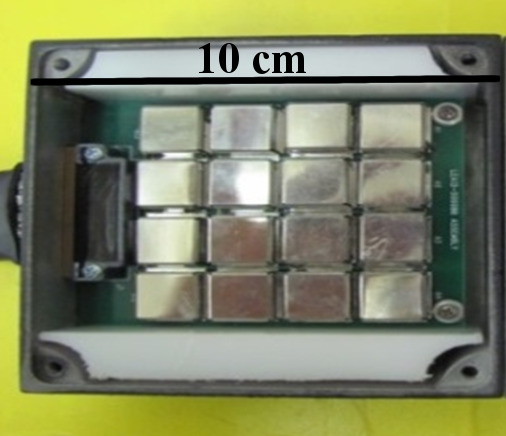
We split the 32 detectors into two heads of 16, about 10.5 cm^2 each, for 21 cm^2 total. Each detector gets its own charge-sensitive preamplifier and shaping amplifier at 1 microsecond shaping, the shaped output is discriminated to a TTL pulse, and the pulses are summed and recorded in list mode at 10 ns resolution into a custom multiplicity DAQ. The list-mode data then goes into LLNL's Neutron Multiplicity Analysis Code, which runs the standard moment analysis. We tested against a 35 microCi (65 ng) Cf-252 source at about 6 cm, with 4.5 cm of polyethylene moderator between source and detectors and 5 cm backing them. Overall system efficiency came out to 0.3%.
The result
 hover / hold for original
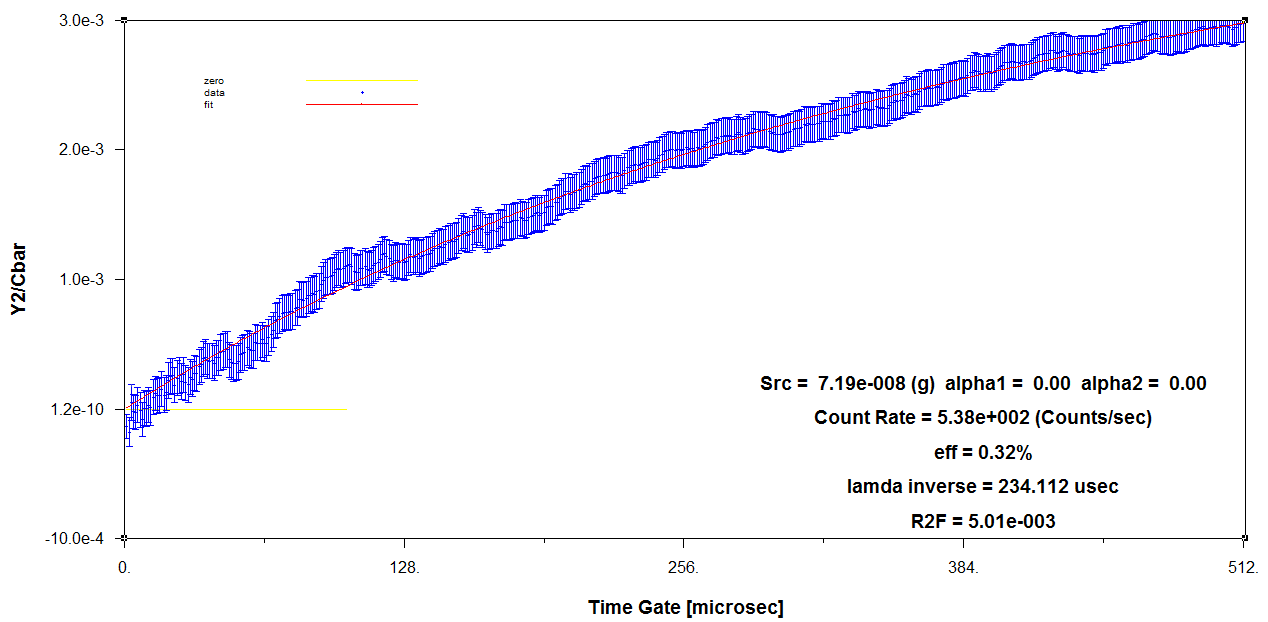
On the full 21 cm^2 array the extracted mass error drops below 20% at about four hours and stays under 10% past 24 hours. The mass error falls roughly as t^(-1/2) in run time, with a fit exponent of 0.54. Because the doubles rate goes as eps^2 and efficiency scales with active area, the obvious lever is area, not cleverness. The scaling predicts that 40 cm^2 would hit 20% error in about an hour, and 80 cm^2 in roughly 15 minutes. Those last two are projections from the eps^2 argument, not measurements, so treat them as the direction the trend points rather than promises.
The smaller arrays make the same point from the other side. With only 5 cm^2 of area the four-hour mass error was 89.5%, which says accurate assay of a source this weak is just not on a reasonable timescale at that area. Four times the area gets you there, exactly as eps^2 demands.
The tension, and the wearable idea
There is a design conflict buried in the numbers. The die-away time of the system was high, over 200 microseconds (234 microseconds in the run above), against tens of microseconds for a typical He-3 well counter. Die-away is set by how long thermalized neutrons rattle around the moderator before they are captured or leak out, and we have a lot of moderator: polyethylene both in front of and behind the detectors. We need that moderation because fission neutrons are fast and boron's capture cross-section only gets large once they are slowed to thermal. So more moderation buys efficiency but lengthens die-away, and long die-away forces wider gates and more accidentals. MCNP simulations of the moderator geometry suggest the sweet spot is 3 to 6 cm of high-density polyethylene; beyond about 3 cm of backing the returns fall off. Whether you optimize for peak efficiency or for shorter die-away depends on the assay you are doing, and that tradeoff is the thing left to work out.
The thin, pixelated form factor opens a concept of operations that a rigid He-3 well counter cannot reach. Each detector is on the order of 1 cm^2 and the heads are under 1 cm thick, so the array can in principle be tiled into arbitrary shapes, even wrapped around a source, and eventually integrated into clothing. In that wearable modality the human body becomes the moderator. The wearer's tissue, which is water-rich and hydrogenous, does the thermalizing job that the polyethylene slab does on the bench, and the detectors ride on the outside as a flexible sheet. That is the longer arc this prototype is aimed at, and it is the part I am least sure of, since it depends on getting the area and die-away tradeoff to land somewhere a person can actually carry.
For the background on why neutrons need converters at all, and the thin-film detectors I built in grad school before this, see Detecting Neutrons. The full device fabrication and the multiplicity system description are in this Nuclear Instruments and Methods paper, and you can find more of my scholarly work on my Google Scholar Profile.